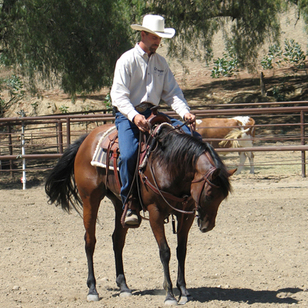
Horse Training Bit


go to home pageKeith Hosman's biosend us an emailJohn Lyons links and morestep by step horse training email
go to: homepage go to: homepage go to: homepage


Sign Up Today!

If your horse is buddy sour or won't speed up, slow down, or pick up its leads, you missed the latest training methods from John & Josh Lyons. Sign up here to get step-by-step lessons emailed every month free.

country

Note: We will not sell you out to spammers.

Sample Our Newsletter
"An Exercise For When You Can't Ride," Issue 1, part 3 of our FREE monthly newsletter

From our Horse Ground Training Series:

Take your left hand and hold the lead rope as if it's the left rein. Pull the halter slowly toward yourself.

"Concentrate. Feel how much pressure it takes to bring that rope toward you. You should feel on your pinky how many ounces it takes. Throw it back out and do it again. This time close your eyes and really concentrate. If you get this lesson, horse training gets a whole lot easier. Really focus on what it feels like. How many ounces is it taking to bring that halter back to you? Think of a specific number. How many pounds? How many ounces? One or two? 5 pounds or 5 ounces?

"How would you like your horse to be that soft? A pound or two doesn't seem so bad, does it? Actually, it's terrible. Having to put a pound or two of pressure on the rein to get it to "come back to you" is just terrible. Take the halter off the lead rope now and throw the rope back out, snap end first.

"Do the same thing, drag the snap back to you. How does that feel? It feels pretty light, right? You feel a big difference. But that's still terrible. Now take the lead rope and throw the opposite end out, the end without the snap. That feels really light. It feels like nothing. It's still terrible.

The reason it's terrible is because…

(sign up / read more)


From John Lyons Trainer Keith Hosman


Trailer Training Horses
A Downloadable Book

A sample from Day 3:

Back in the safe zone, some distance from the trailer, we'll tap until the horse moves some part of his body forward. As before, pawing, sniffing and leaning are all signs that he's thinking about it. Quit tapping when he paws, for instance, but use common sense here: If your horse is just pawing and you've found yourself in a stalemate, then increase your taps and irritate him more. Resist the urge to give him a good whack – that'll only teach him that he was right to be scared the whole time. Worse, he'll soon learn that he can survive the pain and you've got to hit him harder. It's a downward spiral from there. "Be the fly" and move your horse gradually to a point where he's standing looking in on the right side and you are behind the closed left door.

- Print out from home
- 5 Days, 5 chapters
- Learn at your own pace

Just $4.99

For more info:
this course | all courses

Available Downloads:
"Stop Bucking"
"Rein/Speed" (for Nervous Horse Owners)
"Round Pen First Steps"
"Trailer Training"


clinic infowhat people say about our clinicsshop online
browse article archiveperuse articles from outside writersfind training by relevant topicsee past issues of the newsletter5-day study courses, download then print outlisten to training online


Lyons Training 101

Issue Number:  Two
Making Improvements

written by Josh Lyons & Keith Hosman
 
Issue Two, Part 2 of 2
The Snaffle Bit vs The Shank Bit


Print This Article (This is a large file that will take a moment to load. Note: the article might be paired with another.)
Tell A Friend (Click to send them an email)
Link to this Article (Click for code and instructions)
& lead directly to your country's eBay site for current listings of related products selling near you
Find this article faster next time:  

The snaffle bit allows me to work my horse's head from side to side and to get him to begin to utilize his neck. With a snaffle bit, if I pick up the reins and I putt ten pounds of pressure on the rein, that's exactly what the horse feels, ten pounds of pressure. It's pound for pound. If I pull a pound here he feels a pound there. With a leverage bit, if I pull 1 pound he feels 10 pounds down there. That's a big difference. When I train my horses, I predominantly use a full cheek snaffle bit. Should you ever use a shank bit? Yes, simply because shank bits are often required in the show arena.

Full Cheek Snaffle Bit

• the bit that John Lyons uses and recommends
see more


Buy now: $38.99

A gives me the feeling of having more control than I actually have. But, in fact, the leverage (or shank) bit doesn't give me any more control than any other bit. If I have to pull 5 pounds to stop my horse on that bit, I still have to put 5 pounds on this bit. Except I'm only pulling about a pound's worth because a pound from me feels like ten down there due to the leverage created. It makes me feel like I have more control. It makes me feel like the horse is softer and more responsive, But if I allow him to, the horse will soon begin pulling on the shank bit - just as he would any snaffle bit.

A leverage bit will allow me to teach him to keep his head straight and break at the poll – but that's about all I'm going to be doing. I do use a leverage bit, if I want to work on keeping horse's head in position or to keep him square between the reins. But while the bit might be keeping his head correct, it's my body, my seat that's telling him where to go. For instance, if I were riding toward you and I tell the horse to take his hips to the left and his shoulders to the right or the left, then it's my body that's telling the horse how to move, not the bit. The bit is just keeping him "in frame."

The reason then that I don't train in a curb or leverage bit is that I can't work the horse side to side; I can't work him vertically and I have no way to correct him. If I'm using a leveraged bit and the horse doesn't move off my leg, I'm not able to pull his head off to the side and correct him. All he feels when I put pressure on the reins is pressure on both sides of his face and he'd simply keep driving his head down.

Regarding types of : It makes no difference what specific kind of snaffle bit you use. You can use an O-ring or D-ring or full cheek. If it's an , use a chin strap to keep it from pulling through the horse's mouth if you were to pull and it was to open it's mouth too wide.

Some horses will panic when they first feel that sort of pressure. So in that respect, a snaffle bit will actually get a horse to calm down faster because the bit doesn't scare them. You may want to work with a shank bit occasionally so that when (or if) you show your horse it doesn't panic from the pressure. It's a different type of pressure because it applies pressure at different points of the horse's head. It’s also more severe because of the leveraged effect. With a snaffle but you can pull like crazy and the horse will just lay on it. But, if you were to get a horse light in a snaffle bit, then put a leverage bit in their mouth, the horse is much more sensitive. It gives you a little extra edge in the show ring - in your stops for instance

End of Issue Two, Part 2


***


Read previous article: How Long You Should Ride

Read next article: Horses That Pull Back or Won't Stand Tied

See Complete List of Articles

***


Related Letters
 

See related Questions & Answers (letters from readers like you)


back to top


***

Disclaimer: Equine training can be a hazardous activity which may subject the participants to possible serious injury. Keith Hosman, his associates, and other trainers listed on this site will not assume any liability for your activities. Our newsletter, books and videos provide general information, instruction and techniques that may not be suitable for everyone. No warranty is given regarding the suitability of this information, the instructions, and techniques to you or other individuals acting under your instructions.

All Rights Reserved (TM) 2008, horsemanship101.com
No part of this website, including newsletter material and photos, may be reproduced without our express written permission.


Get the performance and relationship with your horse you desire. We'll automatically let you know when a clinic's coming to your area when you sign up for our free training newsletter, (upper-left sidebar, this page).

country supply horse tack | horse shop tack | horse supply tack | horse tack catalogs | equipment tack western | horses tack saddles | tack used western | used tack shop | wholesale horse tack and supply | horse tack sale | bag horse leather saddle | gear leather riding | quarter horse saddle | horse training halter | horse snaffle bits


PRIVACY POLICY

Lyons Training 101: Issue Two, Part 2
"Horse Training Bit: Snaffle Bits vs Shank or Leverage Bits"
bookmark Horsemanship101.com for more info


AUDIO CLIP
Listen to Josh Lyons

Click Josh's picture to play
"Nervous Horses"

Nervous Horses

Note: Audio clips are large files and may take several moments to load.

Read Josh's bio


Josh Lyons

One of the most sought-after clinicians in his own right, John Lyons' son Josh has produced a winning DVD series for the performance horse owner.


Josh Lyons Foal Handling
Buy today: $38.99


Josh Lyons Teaching Tricks
Buy today: $38.99


Josh Lyons Spins and Shoulder Control
Buy today: $38.99


Josh Lyons Leads and Lead Changes
Buy today: $38.99


Josh Lyons Sliding Stops and Rollbacks
Buy today: $38.99


Josh Lyons Teaching Series
Buy today: $158.99


Essential John Lyons

There are certain products that every long-time Lyons fan carries in his equine tool kit. They're the "gotta haves." Here are a few essentials - as recommended by this John Lyons Certified Trainer, Keith Hosman.


Bringing Up Baby
Buy today: $23.99

Help Me Help My Horse
Buy today: $25.99

John Lyons Reins
Buy today: $41.99


John Lyons Audio

Don't waste another moment sitting in traffic! Listen to John Lyons discuss simple solutions to common horse problems.


Conversations with John Lyons
$98.00


Fear in the Rider, Fear in the Horse CD
$28.99


Getting Your Horse's Attention CD
$28.99


Horse That Bites, Abused Horse CD
$28.99


Sensitive Ears, Mouth, & Feet CD
$28.99


The Calm Down Cue CD
$28.99