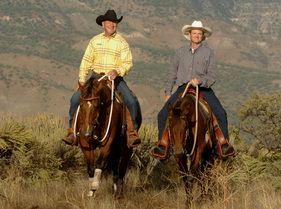
Equestrians: Find A John Lyons Horse Trainer Near You
Mapclick for a map showing trainer locations in the U.S.
• see if a pro lives near you at a glance
• click on the "green dots" for more info about that trainer
• use your browser's "back button" to return to this page
15805 E. Lonesome Lane, Chandler, AZ 85249 USA
Email: Ssikora15805*aol.com (replace * with @), Site: www.ssequinetraining.com
John Lyons horseman Stephen Sikora lives in Central Arizona (Maricopa county) within 100 miles of the following cities: Mesa, Peoria, Phoenix, Casa Grande, Sun City.
Lazy J2 Ranch PO Box 547, Patagonia, AZ 85624 USA
Email: sidney*dakotacom.net (replace * with @)
John Lyons horseman Sidney Spencer lives in Southeastern Arizona (Santa Cruz county) within 100 miles of the following cities: Sierra Vista, Bisbee, Tucson, Oro Valley.
170 E. Camino de Pampas, Huachuca City, AZ 85616 USA
Email: blackhorse42*yahoo.com (replace * with @)
John Lyons horseman Stevan Wren lives in Central Arizona (Cochise county) within 100 miles of the following cities: Benson, Sierra Vista, Tucson, Willcox.
7603 S Acacia Ln, Vacaville, CA 95688 USA
Email: alvaradoequine*aol.com (replace * with @), Site: www.alvaradoequine.com
John Lyons horseman Luis Alvarado lives in Northern California (Solano county) within 100 miles of the following cities: Stockton, San Francisco, Sacramento.
2630 Virginia Dr., Brentwood, CA 94513 USA
Email: trainingbysarah*yahoo.com (replace * with @), Site: www.trainingbysarah.webs.com
John Lyons horseman Sarah Burnside lives in Northern California (Contra Costa county) within 100 miles of the following cities: San Francisco, Berkeley, Modesto and San Jose.
6636 - 24th Street, Rio Linda, CA 95673 USA
Email: thermeagle*aol.com (replace * with @)
John Lyons horseman Deven Childers lives in Northern California (Sacramento county) within 100 miles of the following cities: Citrus Heights, Roseville, Folsom, Sacramento, San Francisco, Stockton, Modesto, Fremont.
5426 San Felipe Rd., Stockton, CA 95203 USA
Email: workinclass*pcwi.net (replace * with @), Site: www.workinclassranch.com
John Lyons horseman Kriss Costa lives in Northern California (San Joaquin county) within 100 miles of the following cities: Stockton, Manteca, Lodi, Modesto, San Francisco, Sacramento, Merced.
1821 Keyes Road, Ramona, CA 92065 USA
Email: KandLRanch*aol.com (replace * with @)
John Lyons horseman Kay Cox-Eveleigh lives in Southern California (San Diego county) within 100 miles of the following cities: Escondido, Ramona, Rosemont, San Marcos, San Diego, Temecula.
PO Box 741, Valley Springs, CA 95252 USA
Email: rfordrandy*aol.com (replace * with @)
John Lyons horseman Randy Ford lives in Northern California (Calaveras county) within 100 miles of the following cities: Sacramento, Stockton, San Jose, South Lake Tahoe.
300 Redrock St, Anaheim, CA 92807 USA
Email: rednightdan*hotmail.com (replace * with @)
John Lyons horseman Daniel Gardner lives in Southern California (Orange county) within 100 miles of the following cities: Anaheim, Yorba Linda, Orange.
PO Box 465, 6557 W Drummond Ave; Inyokern, CA 93527 USA
Email: bar_g_ranch*yahoo.com (replace * with @), Site: www.barghorseranch.com
John Lyons horseman Beth J. Gordon lives in Central California (Kern county) within 100 miles of the following cities: Bakersfield, Lancaster, Wasco, Ridgecrest, Barstow.
PO Box 375, Yuba City, CA 95992 USA
Email: wendell*dalelgreen.com (replace * with @)
John Lyons horseman Wendell Green lives in Northern California (Sutter county) within 100 miles of the following cities: Yuba City, Citrus Heights, Sacramento, Stockton, Santa Rosa, Reno.
"The next thing you'll do (or the first, if you've got that aggressive horse mentioned above) is to nail your outside turns. When you began, an outside turn would have been easy. Your horse was probably dying to turn away (read: run away) from you. But, we've just taught him to turn in and that's what he'll expect you to be asking for the first few minutes. Those who begin with inside turns should expect this behavior when transitioning to outside turns and vice-versa.
What you'll do to get your outside turns is to simply change the way you carry your hips: Now you'll be walking at the horse's head, concentrating on driving it with your body language into the fence or wall. Note here that if your horse is going 87 million miles an hour around in a circle, asking for an outside turn (when it's new to him) is just asking for trouble. Back off a tad and allow the horse to slow a bit, then walk toward the front end of the horse, pushing it into the fence/wall. (You may need to begin this "pressure" half a round pen away if the horse is traveling at a good clip. Give them time to know it's coming, don't spring it on them.) Sometimes it helps to raise your hand and motion toward the horse head, sort of "pointing it" toward the fence. With the inside turn you were, in effect, backing away, inviting the horse's head and neck with your body. With the outside turn your walking toward the front of the horse. You only need to do about ten outside turns either direction and your horse should have it down pat. Just watch to see how well he's reading your body language. If you can make a rather subtle move and the horse correctly reads it as a request for a inside or outside turn, then you know he's got it."
- Print out from home
- 5 Days, 5 chapters
- Learn at your own pace
"Here are 3 "Rider Checklists" from John Lyons Trainer Keith Hosman: Together they'll keep you safer and accelerate your training to boot.
I'm going to give you three "Rider Checklists" today. Together they'll keep you safer and accelerate your training to boot. How accelerate? They'll keep you rational; they'll keep you from "losing it" - which has the effect of setting your training back. The fact is, when we don't have an objective means of approaching our training, when we simply "ride," reacting emotionally to what's happening, we're asking for a wreck - or at the very least, a bad day. The horse gets confused and we get frustrated or lose our temper. Not an environment conducive to a proper education, would you say?
Each of the following lists will cover small things you can simply check off in your brain. Basically, has something happened or not? If the answer is "not," I'll tell you what to do. Your answers to those questions will, flowchart-like, tell you how to act in the moment or how best to form your day's game plan.
The lists were created to "be done in order."
Checklist One: How To Keep From Totally Losing It
Before you ever get on your horse, back when you're approaching the barn, ask yourself one easy question: "Am I training today or am I joyriding?" If you answer "training," skip to Checklist Two. If you answered "Uh, I'd like a day off from training, please. I got a horse to have FUN, Mr. Wet Blanket Trainer Man" - that's great, too. It's great as long as you can honestly say that not once in the last few days or months have you turned to a friend and said something akin to "Flicka nearly bucked my teeth out back there" or "This (expletive deleted) horse keeps trying to eat grass. What's the number for the tiger sanctuary?" If there are known issues, then it doesn't matter where you ride (trail or arena), the fact is, you need to be training as opposed to joyriding.
At clinic after clinic, here in the states or in Europe, I get a version of the same question: "I'm out on the trail. On a cliff. With a ten thousand foot drop to my right and cactus on the left. My horse hates plastic bags - but one blows by and he freaks. What do I do?" To which I answer something akin to "Say your prayers." See, training is not a widget that you carry in your back pocket and pull out like a parachute when the plane goes down. It's about practice and preparation. Ignoring warning signs and riding into potential disaster is like eating a cake every night and suddenly freaking when the scale reads "300."
If riding your horse has become an aggravation or something that - even at times - frightens you, then you gotta answer "training" until riding is fun again. Following this simple thought process will have a bigger impact than if I told you to specifically do a, b, or c - because there are trillions of horse/rider combinations and situations that might be described. So, with a nod to the ol' John Lyons axiom "Ride Where You Can, Not Where You Can't," we'll consciously pick a reasonably safe place to do our training and get at it. Example One: Is your horse "jiggy"? Then you need to capture his attention by improving his performance. How do you do that? By being a proactive rider. Keep giving the horse something to do. Make him spin enough plates and he'll hand you control. Example Two: Does your horse keep munching grass? Then develop a zero-tolerance policy toward any resistance on the part of your horse. Be on the lookout for resistance in the form of a stiff neck or a horse that won't move forward when asked. Don't wait till his head's on the ground. Test constantly and the instant you feel reticence, correct the situation. If you feel an ounce of stiffness in the neck, apply pressure and get the horse moving till he relaxes, then you relax. Teach the horse that the way to get you out of his mouth is to stay soft and obliging. The answer is the same if he drops to a speed you didn't ask for. Be ready with a good kick and swift reward. If you just thought to yourself: "That's what I do and it doesn't work" then what's happening is that you're keeping pressure on the horse's mouth all the time (example one) or kicking all the time (example two). The horse has learned "I get punished no matter what I do so I might as do what I wanna do." Learn to be more aware of when you're applying pressure. It doesn't matter what you think you're doing, your horse's actions tell a different story."